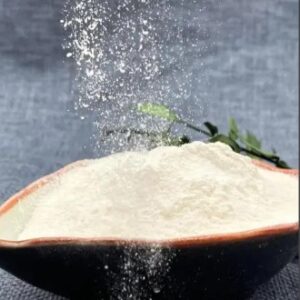
Soy crisp (soy protein crisps, 80% protein on a dry basis) is a puffed, crisp particulate made from soy protein isolate and a small amount of starch or flour, extruded and dried into rice- or oval-shaped pieces. It is the texture carrier in high-protein bars, breakfast cereals, snack clusters and confectionery: it puts protein into a product without the chalky mouthfeel of a powder, and it survives the compression that a bar goes through on a packaging line. PolyBlueChem supplies the 80% grade with bulk density 260-300 g/L, fat 1% maximum and a non-GMO identity-preserved chain; a 90% protein grade is available against a specific enquiry.
Specifications: proximate and physical
| Parameter | Specification | Note |
|---|---|---|
| Protein (dry basis) | 80% min | Kjeldahl, N x 6.25 |
| Fat | 1% max | low fat keeps the crisp from going rancid in storage |
| Moisture | 10% max | drives both crispness and the as-is protein figure |
| Bulk density | 260 – 300 g/L | tapped; the single most important handling number |
| Shape | Rice or oval | selected against the target product |
| Colour | Natural, uncoloured | no added colour |
| Odour | Natural | bland soy note; see the masking note below |
Specifications: microbiology
| Parameter | Limit |
|---|---|
| Total plate count | 10,000 /g max |
| E. coli | Negative |
| Salmonella | Negative |
| Mould and yeast | 100 /g max |
| Coliforms | 10 /g max |
These limits are set for ready-to-eat use: a protein bar or a cereal is not cooked after the crisp goes in, so the microbiological load of the ingredient is the microbiological load of the finished product. Buyers who run a low-moisture, high-fat bar should also ask for the water activity of the finished bar, because a crisp at 8-10% moisture in equilibrium with a soft binder can migrate to a chew rather than a crunch within weeks – see the packaging and shelf-life section.
What “80% protein” actually delivers
The 80% figure is on a dry basis, which is the standard way the industry quotes it, and the difference from the as-is number is large enough to matter in a formulation and in a price comparison:
| Basis | Calculation | Result |
|---|---|---|
| Dry basis (as quoted) | – | 80% protein |
| As-is at 10% moisture | 80 x (1 – 0.10) | 72% protein |
| As-is at 8% moisture | 80 x (1 – 0.08) | 73.6% protein |
| Protein per 100 g of crisp | – | 72 g at the 10% moisture limit |
Two consequences follow. First, a supplier quoting “80% protein” at 10% moisture and a supplier quoting the same figure at 6% moisture are not selling the same amount of protein per tonne – the difference is about 3% of the protein paid for. Always compare at the same moisture, or compare on a dry basis. Second, when the crisp is formulated into a bar, the protein claim on the finished product has to be calculated from the as-is figure of every ingredient, not from the headline number on the specification sheet.
Bulk density: the number that decides your freight
At 260-300 g/L, soy crisp is a light, bulky material, and this changes the logistics arithmetic completely compared with a powder:
| Quantity | Volume at 280 g/L | Practical consequence |
|---|---|---|
| 1 kg | about 3.6 L | a 1 kg retail pouch is mostly air unless it is filled by weight and settled |
| 25 kg bag | about 89 L | needs a large bag; standard 25 kg sacks are volume-limited |
| 1 tonne | about 3.6 m3 | a pallet of crisp is far taller than a pallet of isolate |
| 20 tonnes | about 71 m3 | a 40 ft high-cube container holds about 68 m3, so the load cubes out before it weighs out |
That last row is the one to plan around: a full container of soy crisp is a volume-limited shipment, not a weight-limited one, which is why landed cost per kilogram is more sensitive to packing density and pallet configuration than to the ex-works price. If your volumes are large, ask for the tapped density of the specific lot and for the bag dimensions before you book freight – a 20 g/L difference changes the container payload by roughly 7%.
Applications
- High-protein bars. The dominant use. The crisp provides crunch and structure in a matrix that is otherwise soft and sticky, and it lets a bar declare a high protein figure without a dense, powdery bite. Typical inclusion is 10-25% of the bar, adjusted against the binder and the target texture.
- Breakfast cereals and clusters. Added to extruded or baked cereals and to granola clusters for protein fortification with visible particulate identity.
- Snacks and savoury inclusions. Coated or seasoned crisps as a protein-bearing snack piece.
- Confectionery and chocolate. As a crunch phase in protein chocolate and in filled bars, where a low moisture pickup is essential.
- Baked goods. In cookies and biscuits at modest inclusion, where the crisp survives baking better than a powder would.
Storage, packaging and the moisture migration problem
Store in a cool, dry place in the unopened bag, away from strong odours: the crisp is porous and picks up volatiles readily, which is why a batch stored next to a flavouring drum can carry that flavour into a neutral bar. Standard packaging is 20 or 25 kg net in multiwall paper or laminated bags with a food-grade liner; nitrogen flushing and foil laminates are available for long sea freight.
The technical issue that catches formulators is moisture migration. A crisp at 8-10% moisture sitting in a binder with a water activity above about 0.6 will absorb water and lose its crunch, and a soft binder will simultaneously lose water and harden. The two processes meet in the middle, usually within four to twelve weeks, and the bar that was crunchy at launch is chewy at month three. The countermeasures are a moisture barrier between phases, a humectant-adjusted binder, a coated crisp, or acceptance of a soft texture as the design intent. Discuss the target water activity with us before the trial, because the crisp grade and the coating can be selected around it.
The 90% grade and other shapes
We also supply a 90% protein crisp and a range of shapes and densities. Both are quoted against a specific application rather than stocked as catalogue items, because the right combination depends on the bar’s binder, the target protein claim and the filling equipment. Send the finished-product specification and we will return the grade that matches it.
Frequently asked questions
Is soy crisp the same as textured soy protein? No. Textured soy protein (TSP) is made from soy flour or concentrate by extrusion and is used as a meat extender with a fibrous, meat-like structure. Soy crisp is made from isolated soy protein with a starch or flour carrier, is puffed to a light crisp, and is used for texture and protein density in bars and cereals.
Is it non-GMO? Yes, material is supplied from a non-GMO, identity-preserved chain with documentation on request. Because soy is one of the most widely planted genetically modified crops, the paper trail matters as much as the claim – ask for the IP certificate and the non-GMO statement with each lot.
How much crisp goes into a bar? Typically 10-25%, but the number is set by the protein target, the binder system and the texture you want. A higher inclusion gives more crunch and more protein but also more breakage in the cut and a drier bite.
What documentation comes with a lot? Certificate of analysis covering protein, fat, moisture, bulk density and microbiology; non-GMO statement; allergen declaration; and SDS or specification sheet for your quality file. BRC, HACCP, ISO, HALAL and KOSHER certification documents are available for supplier qualification.
Allergen and regulatory note
Soy is a declared allergen in the EU (Regulation 1169/2011, Annex II) and the United States (FALCPA), and it must be declared on the finished label wherever it is used. This product is a food ingredient and is not intended for infant formula or for medical nutrition without a specific regulatory assessment for the destination market. PolyBlueChem does not make health or nutrition claims for this material; label claims are the responsibility of the brand owner and must comply with the rules of the market where the product is sold.
Technical background – how the crisp is made, why density and shape matter, and how it behaves against isolate and whey crisp in a bar – is in Soy Crisp 80%: Protein Crisps for Bars and Cereal. For formulation comparison read Soy Crisp vs Isolate vs Whey Crisp, for the texture mechanics read Bulk Density and Texture in Bars, and for purchasing read How to Buy Soy Crisp.
Contact PolyBlueChem at polybluechem@163.com for samples, the 90% grade specification, or a specification signed against your finished-product target.