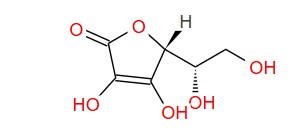
Ascorbic acid 90% granules (CAS 50-81-7) is L-ascorbic acid granulated with starch as the inactive ingredient, giving a nominal 90% vitamin C content in a free-flowing granule. It is the form used where the vitamin is dry-blended into flour, cereal, premix or feed, and where dust, segregation and poor flow would otherwise cause problems on the line.
Specification
| Parameter | Specification | Why it matters |
|---|---|---|
| Identification | Positive | Confirms the material is L-ascorbic acid and not an isomer or a substitute |
| Assay (on dry basis) | 89.0 – 92.0% | The balance is starch; this is a 90% grade, not a diluted 99% grade – price compares on vitamin C content, not on weight |
| Loss on drying | Max 0.7% | Moisture drives oxidative degradation; a high figure shortens shelf life |
| Heavy metals | Max 0.002% (20 ppm) | Food and feed compliance gate |
| Residue on ignition | Max 0.15% | Indicates inorganic contamination from the granulation process |
| Particle size | 90% min through 20 mesh; 25% max through 100 mesh | Coarse granule with little fines – this is what gives the flow and the low dust |
| Total aerobic microbial count | Max 500 cfu/g | Food-grade microbiological limit |
| Yeasts and moulds | Max 100 cfu/g | As above |
| Escherichia coli | Not detected | Required for food and feed use |
Why the granulated 90% form exists
Pure ascorbic acid is a fine crystalline powder. That is ideal for dissolution but poor for dry blending: it dusts, it segregates away from coarser ingredients in a flour or premix, and it can compact in the mixer. Granulating it with starch solves all three problems at once – the granule flows, it stays distributed in the blend, and the starch acts as a carrier that reduces the exposed surface area.
| Property | 90% granules | 99%+ fine powder |
|---|---|---|
| Vitamin C content | About 90% | 99% and above |
| Flow and dosing | Free-flowing; suits volumetric feeders | Poor flow; needs special handling |
| Dust | Low | High – an occupational and housekeeping issue |
| Segregation in dry blends | Low, because the granule size matches typical carriers | High – fines migrate through the blend |
| Dissolution rate | Slower | Fast |
| Cost per unit of vitamin C | Higher (10% of the weight is starch) | Lower |
Applications
- Flour and bakery premixes – dough conditioning and oxidative stability; the granule disperses evenly through the flour without dusting the mill.
- Cereal and grain fortification – where the vitamin has to survive blending, conveying and packing without separating out.
- Feed premixes and compound feed – vitamin C supplementation for poultry, swine and aquaculture, blended with other micro-ingredients.
- Tablet and capsule blends – where a free-flowing granule feeds the press more evenly than a fine powder.
- Dry beverage and nutritional blends – for products reconstituted by the consumer rather than dissolved in the plant.
Packaging, storage and documentation
| Item | Detail |
|---|---|
| Packaging | 25 kg paper sacks or cartons with PE liner; bulk bags on request |
| Storage | Cool, dry, out of direct sunlight; keep the liner sealed. Ascorbic acid oxidises faster with heat, moisture and metal contact – avoid steel scoops left in the bag |
| Shelf life | Confirm on the batch COA; the assay is on a dry basis, so re-test if the material has been open for a long period |
| Documentation | Batch COA (assay, loss on drying, heavy metals, particle size, microbiology) plus SDS and a food-grade statement |
| Regulatory | Food additive E300 in the EU; confirm the grade statement your market requires |
For the technical background, grade comparison and buying checklist, see the ascorbic acid food antioxidant guide and the comparison of 90% granules against fine powder.