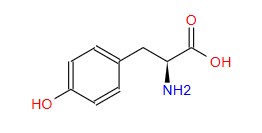
L-Tyrosine (CAS 60-18-4) is a proteinogenic aromatic amino acid supplied to the USP 39 monograph. This grade is specified on assay, specific rotation, individual and total impurities, the heavy-metal group (including lead, cadmium and mercury separately) and microbiological limits – the full set of parameters a pharmaceutical or nutritional customer actually reviews on the certificate.
Specification (USP 39)
| Parameter | Limit | Why it is on the specification |
|---|---|---|
| Assay (on dry basis) | 98.5 – 101.5% | Tight two-sided window – the upper bound matters as much as the lower one for a monograph grade |
| Description | White crystals or crystalline powder, tasteless | First-line visual check on receipt |
| Specific rotation [alpha]D 25 | -9.8 deg to -11.2 deg | Optical purity: D-tyrosine or racemised material shows up here before it shows up anywhere else |
| Chloride (Cl) | Max 400 ppm | Residual from neutralisation and ion-exchange steps |
| Sulphate (SO4) | Max 400 ppm | As above |
| Iron (Fe) | Max 30 ppm | Iron catalyses oxidative discolouration of the product |
| Lead | Max 3 ppm | Elemental impurity, reported separately under current USP practice |
| Cadmium | Max 1 ppm | As above |
| Mercury | Max 0.1 ppm | As above |
| Heavy metals (as Pb) | Max 15 ppm | Group limit alongside the individual elements |
| Arsenic (as As2O3) | Max 1.5 ppm | Elemental impurity |
| Any individual impurity | Max 0.5% | Controls single unknown or process-related peaks |
| Total impurities | Max 2.0% | Controls the summed profile – the parameter that separates a monograph grade from a technical one |
| Loss on drying | Max 0.30% | Low-moisture specification; the material is only slightly hygroscopic but is specified dry |
| Residue on ignition (sulphated) | Max 0.40% | Inorganic residue |
| Total plate count | Max 1000 cfu/g | Microbiological limit |
| Yeast and mould | Max 100 cfu/g | As above |
| Salmonella / Staphylococcus aureus / Coliforms | Not detected in 25 g | Absence tests required for pharmaceutical and nutritional use |
| E. coli | Negative | As above |
What each group of parameters is actually controlling
| Group | What failure means | Where it comes from |
|---|---|---|
| Assay outside 98.5-101.5% | Under-assay means residual moisture or impurities; over-assay usually means the drying step was incomplete when the sample was taken | Fermentation, isolation and drying |
| Specific rotation out of range | Partial racemisation or D-tyrosine carry-over – a defect that assay alone will not reveal | Racemisation during hydrolysis or purification |
| Individual and total impurities | Process-related peaks, including other amino acids and degradation products | Feedstock quality and chromatography |
| Elemental impurities | Catalyst and equipment carry-over | Reactor and centrifuge materials, water quality |
| Microbiology | Hygiene in drying and packing | Open handling after the last purification step |
Typical applications
- Pharmaceutical intermediates – a starting material in the synthesis of levodopa and related active ingredients, where optical purity is the decisive property.
- Nutritional and clinical nutrition – tyrosine is conditionally essential; it matters particularly where phenylalanine intake is restricted.
- Cell culture and fermentation media – a defined component of amino acid blends.
- Cosmetic and personal care formulations – as a skin-conditioning amino acid in leave-on products.
- Feed and specialty nutrition – where a defined purity grade is required rather than a feed-grade hydrolysate.
Packaging, storage and documentation
| Item | Detail |
|---|---|
| Packaging | 25 kg fibre drums or paper sacks with double PE liner; smaller packs on request |
| Storage | Cool, dry, sealed, away from light. The material is only slightly hygroscopic but is specified at max 0.30% loss on drying, so protect it from moisture and from iron contact |
| Documentation | Batch COA written against USP 39 (assay, specific rotation, impurities, elemental impurities, microbiology) plus SDS |
| Regulatory | Confirm TSCA and REACH status for the CAS on enquiry; the grade statement is what your customer’s audit will ask for |
For the technical background and grade comparison, see the L-tyrosine properties and production guide and the USP 39 specification walkthrough.