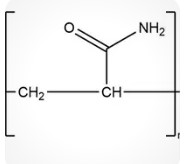
Weak acid cation exchange resin (WAC) is an acrylic-based resin carrying carboxylic acid groups. Its defining property is that it works only above about pH 5 – and in exchange it offers a capacity roughly double that of a strong acid resin and a regeneration efficiency close to stoichiometric. For water with high hardness and high bicarbonate alkalinity, that combination makes it the cheapest way to remove both. Values below are typical for the type; exact figures are confirmed on the grade data sheet.
Typical specification
| Parameter | Typical value | Note |
|---|---|---|
| Polymer matrix | Acrylic (polyacrylate), crosslinked; gel and macroporous forms | The acrylic backbone is what gives the carboxylic functionality and the large swelling |
| Functional group | Carboxylic acid (-COOH) | Weakly acidic – pKa in the region of 4.7, so it only dissociates above about pH 5 |
| Ionic form as shipped | Hydrogen (H+) or sodium (Na+) | Sodium form avoids the large swelling on first use |
| Total exchange capacity | Of the order of 9 mmol/g dry, or 3.0-3.8 eq/L wet | Roughly double a strong acid resin per unit volume |
| Moisture content | About 45-60% | Higher than a strong acid resin of similar crosslink |
| Particle size | About 0.315-1.25 mm | Check the fines fraction – acrylic resins are mechanically softer |
| Wet true density | About 1.10-1.20 g/mL | Lower than SAC; backwash rates have to be set accordingly |
| Swelling, H to Na | Large – of the order of 60-90% | The single most important engineering constraint for this resin |
| Operating pH | About 5 – 14 | Below pH 5 the carboxylic groups do not dissociate and capacity collapses |
| Maximum operating temperature | About 100-120 deg C depending on grade | Confirm per grade |
Why the capacity and the efficiency are both high
A carboxylic group is a small, light functional group compared with a sulphonic acid group, and the acrylic network is less tightly crosslinked, so it holds more water and exposes more exchange sites per unit volume. Regeneration is favourable because the acid form is the natural, un-ionised state – a modest acid excess is enough to drive the reaction, unlike a strong acid resin where regeneration is fought against a favourable equilibrium.
| Property | Weak acid (WAC) | Strong acid (SAC) |
|---|---|---|
| Capacity per litre of wet resin | Higher – roughly 3.0-3.8 eq/L | Roughly 1.7-2.0 eq/L |
| Regenerant consumption | Close to stoichiometric | Several times stoichiometric |
| Working pH | About 5-14 only | 0-14 |
| What it removes | Hardness associated with bicarbonate alkalinity (temporary hardness) | All cations, including those paired with strong-acid anions |
| Swelling on conversion | Very large | Modest, of the order of 8-10% |
| Mechanical strength | Softer beads | Harder beads |
What it is used for
| Application | Why WAC fits | Constraint |
|---|---|---|
| Dealkalisation | Removes bicarbonate hardness and converts alkalinity to CO2 for stripping | Needs the feed to be alkaline – it is a bicarbonate-removal tool, not a general demineraliser |
| Softening high-hardness, high-alkalinity water | Much higher capacity between regenerations than SAC, and far less acid | Does not remove hardness paired with sulphate or chloride |
| Partial demineralisation ahead of a reverse osmosis or a polishing train | Removes the bulk of the load cheaply, protecting the downstream stages | pH of the feed where it is installed must suit the resin |
| Food and beverage water treatment | Efficient alkalinity reduction | Grade must meet the relevant food-contact approval |
The swelling problem, stated plainly
When a weak acid resin converts from the hydrogen form to the sodium or calcium form, it can swell by 60-90% in volume. In a vessel sized for the hydrogen form the bed will either crush against the top plate or lift the distributor. Design consequences:
| Design point | What to do |
|---|---|
| Bed expansion allowance | Size the vessel for the fully swollen (service) form, not the shipped form |
| Loading | Load the resin in a form and quantity that leaves headroom for the conversion |
| Backwash | Expect the bed to sit higher after the first service cycle; set the freeboard accordingly |
| Regeneration sequence | Convert gradually – a sudden full-strength acid step on a swollen bed causes mechanical damage |
Regeneration and handling
Regenerated with hydrochloric or sulphuric acid at close to stoichiometric dose, which is the commercial reason to choose it. Because the resin is mechanically softer than a strong acid resin, avoid excessive backwash rates and sudden flow reversals. Supplied moist in bags, drums or bulk; keep sealed and do not allow to freeze or dry out. A certificate of analysis should cover capacity, moisture, particle size and swelling behaviour.
For the wider selection framework see the ion exchange resin selection guide, and for the strong acid alternative strong acid cation exchange resin.