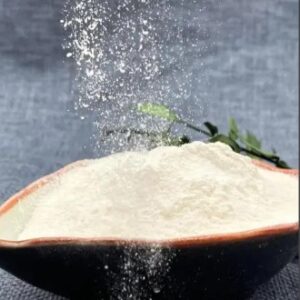
Isolated soy protein, meat type is the grade built for emulsions: high water binding and high fat binding, so it holds brine in a ham, stabilises the fat phase in a sausage, and adds yield to a cooked product without releasing water in the pack. It is a light yellow to milky white powder, 96% through 100 mesh, crude protein 90% minimum on a dry basis, ash 8% maximum, pH 7.0 +/- 1.0 in 5% slurry, and it is supplied against a two-class statistical microbiological plan rather than a single plate-count limit – which is the difference between a grade sold to meat processors and one sold to extruders.
Specifications
| Parameter | Specification | Note |
|---|---|---|
| Appearance | Light yellow or milky white powder | – |
| Moisture | 7.0% max | – |
| Crude protein (dry basis) | 90.0% min | N x 6.25; see the basis arithmetic below |
| Ash | 8.0% max | largely neutralisation salts; relevant if you run a sodium claim |
| Fat | 1.0% max | keeps the powder free-flowing and the flavour clean |
| pH (5% slurry) | 7.0 +/- 1.0 | near neutral, well away from the 4.5 isoelectric point |
| Particle size | 96.0% min through 100 mesh | finer than the extrusion grade; disperses into brine quickly |
Microbiological specification: a two-class plan
| Parameter | Plan | How to read it |
|---|---|---|
| Standard plate count | n=5, c=2, m=5,000, M=10,000 cfu/g | five samples per lot; up to two may exceed 5,000; none may exceed 10,000 |
| Coliform | n=5, c=1, m=10, M=100 cfu/g | five samples; one may exceed 10; none may exceed 100 |
| Salmonella | Negative | absence in the sample size specified on the certificate |
| Staphylococcus | Negative | – |
The n/c/m/M notation is the ICMSF two-class sampling plan and it is a stronger instrument than a single “max” figure, because it controls both the level and the consistency of the lot. What it does not do is guarantee the absence of high counts in an individual bag: with c=2 and n=5, a lot can pass while two of five samples sit between 5,000 and 10,000 cfu/g. If your process has no lethality step after the protein is added, ask for a tighter plan or for a lot-specific result rather than relying on the specification.
Which basis holds the 90%
This grade is specified at 90% crude protein on a dry basis, which is the stricter and more useful way to state it:
| Basis | Calculation | Result |
|---|---|---|
| Dry basis (as specified) | – | 90.0% protein |
| As-is at 7% moisture | 90 x (1 – 0.07) | 83.7% protein |
| Nitrogen equivalent | 90 / 6.25 | 14.4% N |
| Protein per 25 kg bag | 25 x 0.837 | about 20.9 kg |
Compare that with a grade quoted at 90% as-is, which is 96.8% dry basis at the same moisture: the two “90%” products differ by about 7 percentage points of actual protein per tonne. In a meat plant that difference shows up as a different brine strength and a different cooked yield, which is why the basis belongs in the purchase specification, not just on the certificate.
What water and fat binding actually do in a meat system
Soy protein contributes to yield in three ways, and they are worth separating because each is tested differently.
- Water binding / water holding. The protein hydrates and immobilises water in the cooked matrix, which raises cooked yield and reduces purge in the pack. A practical rule of thumb used across the industry is that one part of isolate can take up roughly four to five parts of water in a properly developed system; the actual figure depends on ionic strength, pH, comminution energy and cook schedule, so treat it as a starting point for trials rather than a guarantee.
- Fat binding / emulsification. The protein film stabilises fat droplets during chopping, which prevents fat separation during cooking and gives a firmer bite in fine emulsions such as frankfurters and liver-type products.
- Gel formation on heating. The protein network sets with the myofibrillar proteins and contributes to sliceability and texture.
All three depend on the protein being properly dispersed before it meets the meat. In a brine for injection or tumbling, the isolate should be dispersed into the water phase first, allowed to hydrate, and only then combined – adding powder into a salt-containing brine in one dump produces lumps that never fully hydrate and that show up later as pale specks or as a soft pocket in the cooked product. Detailed dosing arithmetic is in Soy Protein Water Binding in Processed Meat.
Applications
- Cooked ham and formed ham. Added through the injection brine or by tumbling, for yield and slice cohesion; typically 1-3% of the finished product weight as isolate.
- Sausages and frankfurters. In the bowl chopper as part of the emulsion, for fat stabilisation and firmness.
- Quick-frozen prepared foods. Meatballs, patties and dumpling fillings, where water release on thawing is the defect to prevent.
- Flour-based products. Noodles and dumpling wrappers, for dough strength and water retention.
- Vegetarian and meat-analogue products. As a binder and texture component; note that for a fibrous, whole-cut analogue the extrusion grade is usually the better fit.
Storage, packaging and handling
Store sealed, below 25 degC, dry, away from odours. The powder is hygroscopic; opened bags should be closed or consumed within the working period, and a bag left open in a humid room will form lumps that disperse poorly. Standard packaging is 20 or 25 kg net in multiwall paper bags with a food-grade liner; bulk bags are available for plants that dose from a silo or a big-bag station. Typical shelf life is 12 to 24 months unopened.
Frequently asked questions
How is this different from the extrusion grade? Both are 90% protein isolates, but this one is formulated for water and fat binding in emulsions, while the extrusion grade is formulated for low viscosity at high inclusion. Using the meat type in a bar produces an over-thick, sticky mix; using the extrusion grade in a sausage gives poor water holding. See Extrusion Grade vs Meat Type.
Is it non-GMO? Yes – supplied from a non-GMO, identity-preserved chain with documentation. Certificates accompany each lot.
How much should I add? Typically 1-3% of finished product weight in injected or tumbled meat, higher in meat analogues. The right level is set by your brine strength, cook yield target and label constraints; we can supply reference formulations on request.
Can you supply a low-sodium or low-ash grade? Ash in this grade is largely neutralisation salt, so a lower-ash grade means a different neutralisation route. Tell us the sodium limit you need to meet and we will quote against it.
Allergen and regulatory note
Soy is a declared allergen in the EU (Regulation 1169/2011, Annex II) and under the US FALCPA, and must be declared on the finished label. This is a food ingredient; PolyBlueChem makes no health or nutrition claims for it, and any yield, protein or nutrition claim on the finished product is the responsibility of the manufacturer and must comply with the rules of the destination market.
The full technical treatment of grades, dispersion and application fit is in Isolated Soy Protein: Grades, Dispersion and Application Fit.
Contact PolyBlueChem at polybluechem@163.com for samples, certificates or a brine formulation review.